MARiculture Technical INnovations In Sweden (MARTINIS)
Department of Biological and Environmental Sciences and SWEMARC, the SWEdish MAriculture Research Center, University of Gothenburg, Sweden in collaboration with the graduate school of Engineering (Hiroshima University) and the department of chemical engineering (Lund University) (Since 2018)
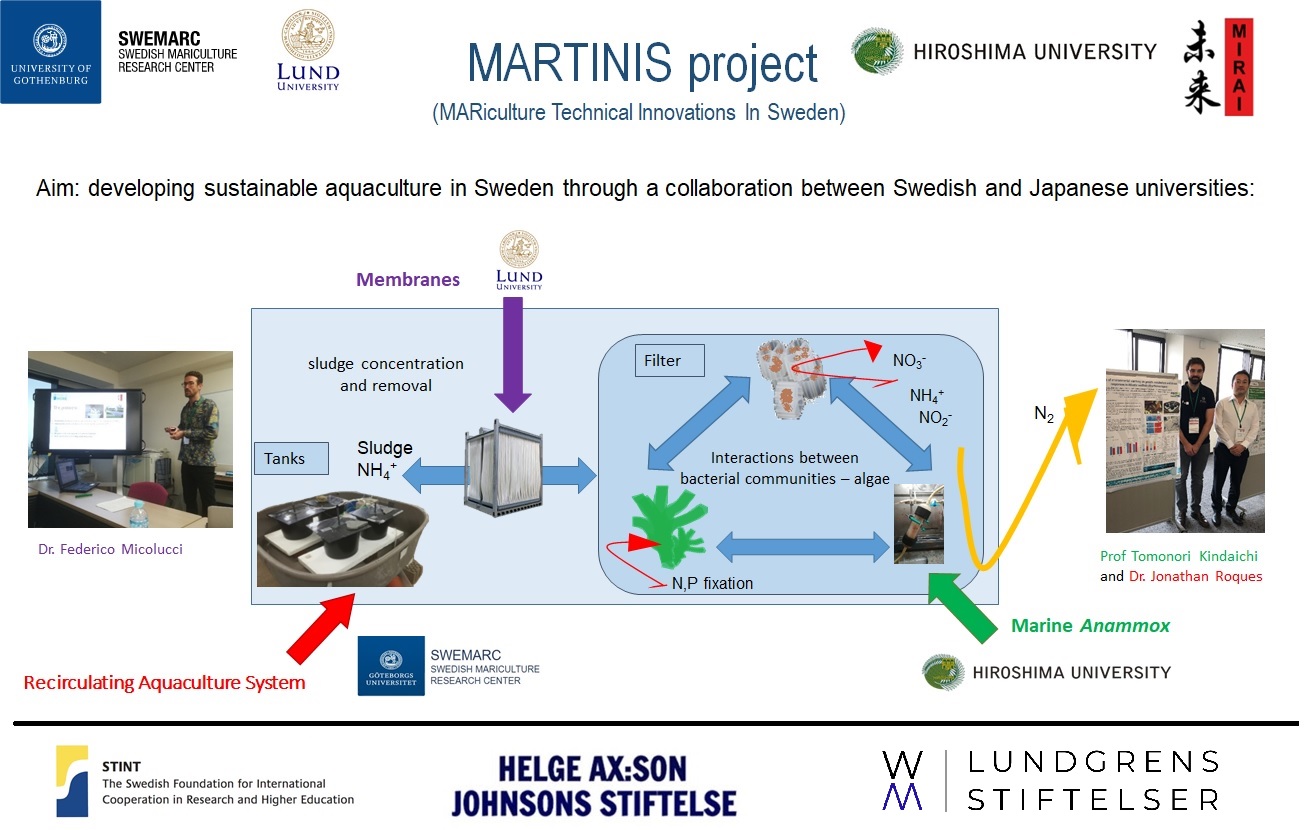
The overall goal of the project is to develop novel land-based multitrophic recirculating aquaculture systems beyond current state-of the art that will be used to build and diversify the Swedish aquaculture sector in a sustainable way.
Specifically, it aims to combine Swedish membrane technology with the use of Japanese marine anammox bacteria as source of wastewater treatment in recirculating aquaculture system.
The MARTINIS project is a collaboration between the Swedish universities of Gothenburg and Lund and the Japanese university of Hiroshima that was forged within the frame of the first MIRAI project (2017-2019). Currently, the project was awarded funding from STINT (Initiation grant), the Swedish foundation for international cooperation in research and higher education and the Helge Axelsson and Wilhelm och Martina Lundgrens foundation to initiate their experiments. In 2020, I received a grant from FORMAS (early career researcher) of 4,000,000 SEK for the period 2020-2025. As of 2026, we have completed several experiments in both countries where we have shown that the marine anammox Candidatus Scalindua could be used to remove anammox in RAS wastewater. We have shown in the laboratory that this bacteria could be slowly adapted to RAS wastewater, and was tolerant to real RAS conditions (high nitrate, low ammonium/nitrite and high oxygen levels. The next step of the project would be to test these laboratory results in real RAS setups.
Stay tuned with the development of the MARTINIS project in the ‘news’ section HERE